
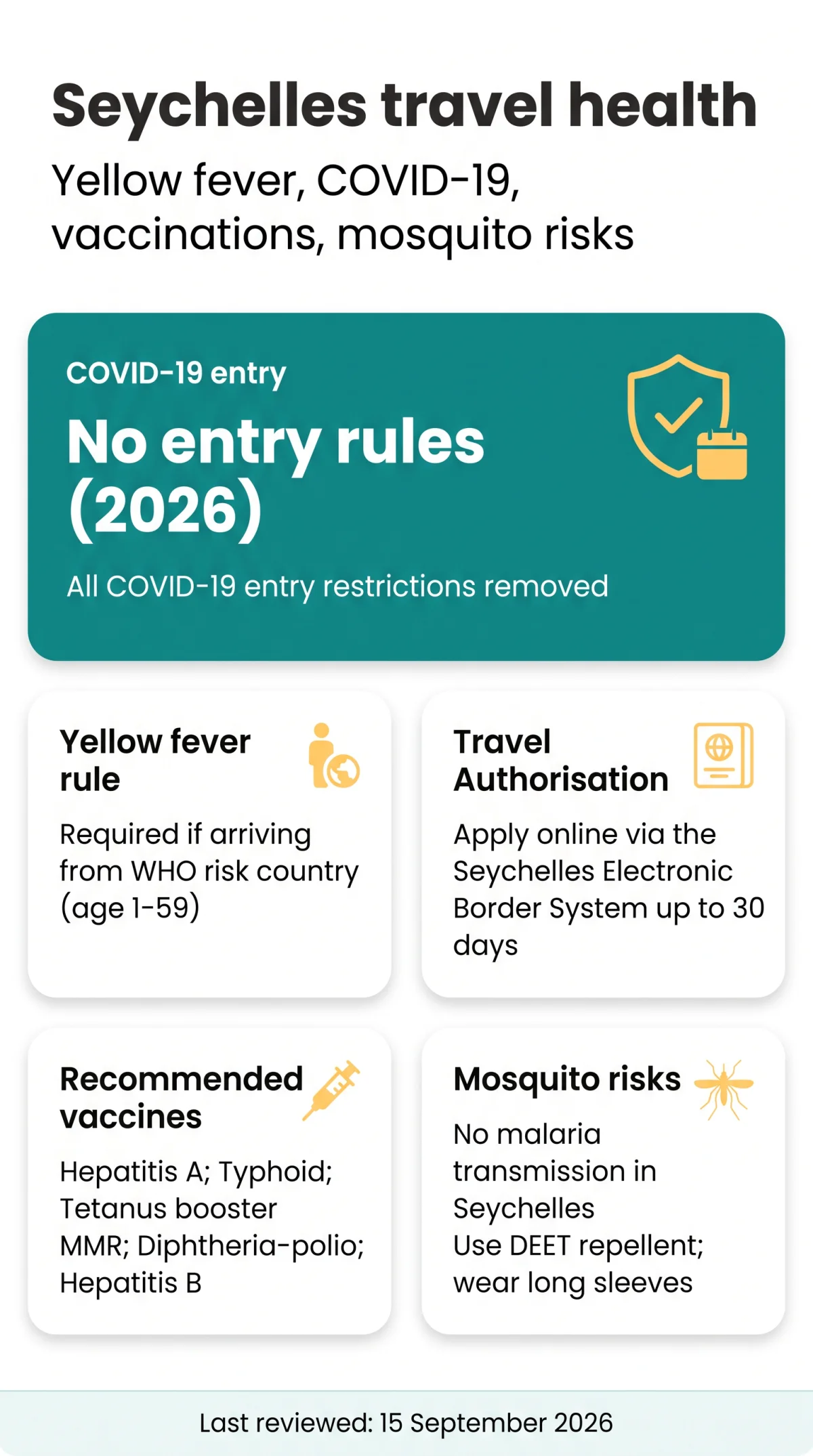
If you are travelling directly from the United Kingdom to Seychelles, you do not need a yellow fever vaccination certificate. The requirement applies only if you have visited or transited for more than 12 hours through a WHO-listed yellow fever risk country. Travellers aged 1-59 arriving from endemic regions must present a valid International Certificate of Vaccination or Prophylaxis (ICVP). All COVID-19 entry restrictions have been removed for Seychelles in 2026.
Last reviewed: 15 September 2026 | Next review due: 15 March 2027. This guide was prepared by a travel health researcher with input from UK-registered travel clinic practitioners.
Yellow Fever Vaccination Certificate Requirements for Seychelles in 2026
Seychelles mandates a yellow fever certificate only for passengers aged 1-59 arriving from WHO-classified risk countries; transit under 12 hours is exempt. Direct UK flights with no transit through an endemic zone are exempt.
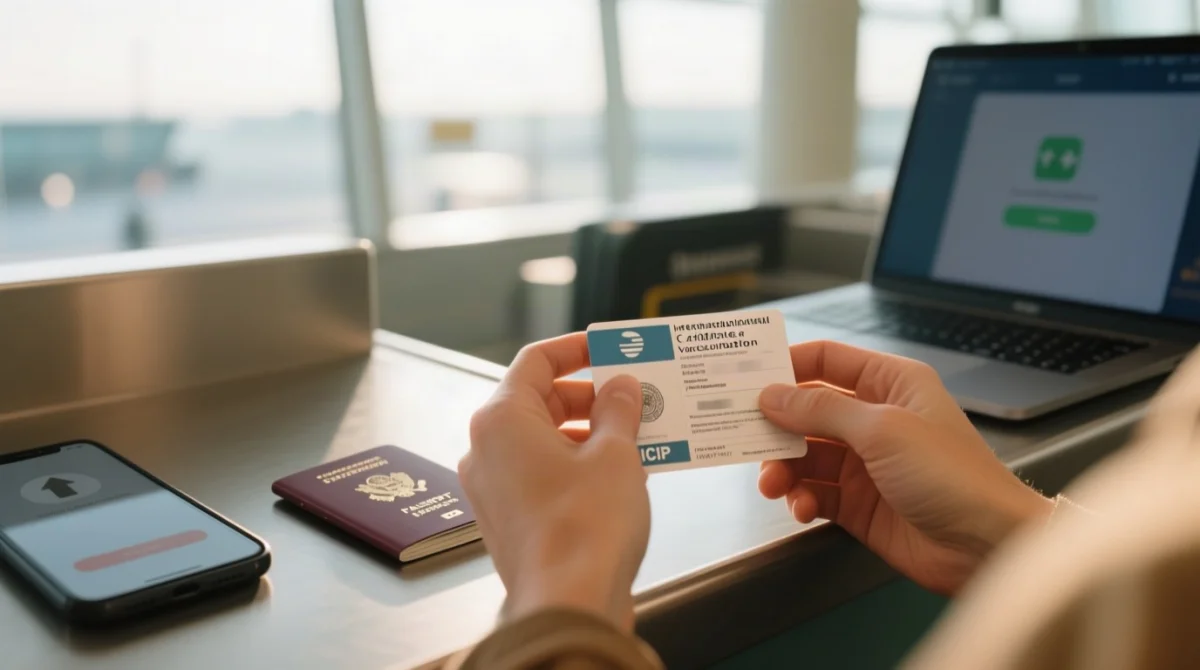
The certificate – an International Certificate of Vaccination or Prophylaxis (ICVP) – is mandatory for travellers aged 1-59 arriving from a risk country. Children under 1 year and travellers aged 60+ are exempt (May 2025 update). Travellers with medical contraindications may obtain a WHO vaccination waiver. As stated in the WHO IHR (2005) Annex 7: “The certificate shall become valid 10 days after the date of vaccination.” A primary certificate becomes legally valid 10 days after administration. Certificates carry lifelong validity since 11 July 2016; rejection on the basis that more than 10 years have passed is prohibited, and no booster can be required. The certificate must be uploaded to the Seychelles Electronic Border System.
Yellow fever vaccination is available at designated Yellow Fever Vaccination Centres registered with NaTHNaC (National Travel Health Network and Centre); the UK high-street travel clinic price (2025) is £82 per dose. UK citizens do not need a visa for Seychelles; a free Visitor’s Permit for 3 months is issued on arrival, extendable in 3-month increments up to 12 months. Your passport must be valid for the duration of your stay. Cash of 50,000 SCR or more must be declared when applying for Travel Authorisation.
Which Countries Are on the WHO Yellow Fever Risk List?
Countries in Africa, South America, and Central America classified by WHO as yellow fever transmission-risk areas trigger the requirement. The full current list of countries with risk of yellow fever transmission is published by the WHO and referenced by the Seychelles Electronic Border System.
Transit Through a Yellow Fever Risk Country
Transit through an airport in a yellow fever risk country for under 12 hours does not trigger the requirement; transit exceeding 12 hours does. Direct flights from the UK require no yellow fever vaccination certificate.
COVID-19 Entry Rules for Seychelles in 2026
Seychelles has removed all COVID-19 entry requirements for 2026. No PCR tests, vaccination certificates, quarantine, or health declaration forms are mandatory.
- PCR / antigen test: Not required for entry to Seychelles in 2026.
- Quarantine: Not required.
- Health declaration form: Not required.
- COVID-19 vaccination certificate: Not required for entry – border health screening does not request proof of COVID-19 vaccination status.
- Travel Authorisation: Mandatory for all UK travellers. Apply online via the Seychelles Electronic Border System up to 30 days before arrival. It is a paid application – check the system for the current fee in Seychellois rupees. Express processing is available for emergencies at an additional cost.
- Required documents: Valid return or onward ticket, proof of confirmed accommodation, and proof of sufficient funds for the duration of stay.
Refer to the latest FCDO travel advice for Seychelles for any last-minute policy changes. Seychelles may reintroduce specific border health measures at short notice.
Is COVID-19 Vaccination Recommended for Travellers to Seychelles?
COVID-19 vaccination is recommended as up to date for all eligible UK travellers by the CDC, but it is not a condition of entry to Seychelles in 2026.
Recommended Vaccinations for Seychelles from the UK
Health authorities recommend hepatitis A, typhoid, and a tetanus booster for UK travellers, in addition to routine MMR and diphtheria-polio vaccinations.
Ensure routine UK vaccinations – MMR, diphtheria-tetanus-polio – are up to date before departure. The CDC issued a global measles Level 1 travel health notice on 28 May 2025; ensure MMR is administered at least 2 weeks before departure.
- Hepatitis A – recommended for unvaccinated travellers aged ≥1 year. An early dose for infants aged 6-11 months does not count toward the routine 2-dose series. Travellers aged 40+, immunocompromised, or departing within 2 weeks may receive hepatitis A vaccine combined with immune globulin at the same appointment. UK high-street travel clinic price (2025): £67 per dose.
- Typhoid – recommended for most travellers; the vaccine is not 100% effective, so safe food and water habits remain essential.
- Tetanus booster – recommended if the last dose was more than 10 years ago. UK high-street travel clinic price (2025): £38 per dose.
- Hepatitis B – recommended for all unvaccinated travellers, especially long-term visitors and those at higher risk. UK high-street travel clinic price (2025): £52 per dose, three doses per course totalling £156.
- Rabies – not commonly found in dogs in Seychelles; post-exposure prophylaxis is available at larger medical facilities.
Malaria and Mosquito-Borne Disease Prevention in Seychelles
There is no malaria transmission in Seychelles and no antimalarial tablets are needed. However, dengue and chikungunya risk exists, transmitted mainly by daytime-biting mosquitoes; Zika may also pose a risk. Chikungunya causes flu-like illness with severe joint and muscle pain that may persist for months. Use DEET-based repellent, wear long sleeves during peak mosquito hours, and use bed nets where accommodation is not air-conditioned.
How to Plan Your Travel Health for Seychelles from the UK
Begin a travel health consultation 6-8 weeks before departure, apply for Seychelles Travel Authorisation up to 30 days ahead, and secure medical evacuation insurance.
Schedule a travel health clinic consultation 6-8 weeks before departure to allow sufficient time for all recommended vaccinations. GOV.UK advises at least 8 weeks; TravelHealthPro advises at least 4-6 weeks. For yellow fever (if required), allow the 10-day certificate validity window after vaccination. People with a health condition or who are pregnant should consult earlier than 6-8 weeks.
Seychelles Travel Authorisation – step by step:
Apply online
Apply via the Seychelles Electronic Border System up to 30 days before arrival.
Pay the fee
Pay the exact amount in Seychellois rupees – check the system for current pricing.
Upload documents
Upload: valid return or onward ticket, proof of confirmed accommodation, proof of sufficient funds.
Express processing
Express processing is available for emergencies at an additional cost.
Travel insurance: Comprehensive coverage for local treatment and medical evacuation is essential – tourists must pay for medical treatment in Seychelles. You may need to show proof of travel insurance at the border. Contact your insurance company quickly upon hospital referral.
Prescription medication: Medicines prescribed or bought in the UK can have different legal status in Seychelles. Carry a doctor’s letter and original packaging. Check TravelHealthPro for current guidance on travelling with controlled substances.
When Should I Get Vaccinated Before Travelling to Seychelles?
Schedule all recommended vaccinations 6-8 weeks before departure. For yellow fever (if required), the certificate becomes legally valid 10 days after administration under IHR 2005 Annex 7. Ensure MMR is administered at least 2 weeks before departure.
Healthcare Facilities in Seychelles
The main hospital is Victoria Hospital in Mont Fleuri, Mahé, with an A&E department and scanning facilities. Local health centres are distributed across most residential areas, and private clinics mostly offer GP services. The emergency number is 999 – ask for an ambulance. Some staff at listed facilities speak English.
For emergencies on Praslin or La Digue, local authorities arrange inter-island transfer to Victoria Hospital on Mahé. Specialist services such as dialysis and intensive care are limited – contact Victoria Hospital in advance for chronic conditions requiring ongoing treatment.
Other Health Risks and Practical Advice for Seychelles
Tap water is generally safe on Mahé but variable on outer islands; equatorial UV index is extreme year-round; reef-safe sunscreen is advised.
- Tap water: Generally safe on Mahé but variable on Praslin and La Digue – bottled water is recommended on outer islands.
- Food and water hygiene: Travellers’ diarrhoea risk is high countrywide (moderate in deluxe accommodations). Practise safe food handling, handwashing, and avoid street food in remote areas.
- Marine life risks: Stonefish, stingrays, and jellyfish are present in coastal waters. Shuffle feet when wading and seek immediate first aid for stings. No hyperbaric chamber is available – evacuation to Mahé for serious envenomation.
- UV and sun protection: The equatorial location means extreme UV year-round. Use SPF 50+ reef-safe sunscreen and reapply every 2 hours. Wear protective clothing, especially during peak hours (10 AM-3 PM). Stay hydrated and wear light, breathable clothing to prevent heat exhaustion.
How we keep this page accurate: This page is reviewed quarterly. For real-time changes, always check the Seychelles Electronic Border System and the FCDO travel advice for Seychelles.
FAQ
Do I need a yellow fever certificate to enter Seychelles if flying directly from the UK?
No. The certificate is only required if arriving from or transiting for more than 12 hours through a WHO-listed yellow fever risk country. Direct UK flights are exempt.
Which countries are on the WHO yellow fever risk list for Seychelles entry?
Countries in Africa, South America, and Central America classified by WHO as yellow fever transmission-risk areas. Check the current WHO list for your itinerary before departure.
What are the COVID-19 entry requirements for Seychelles in 2026?
None. All COVID-19 entry requirements – tests, quarantine, vaccination certificates, health forms – have been removed for Seychelles in 2026.
Are there any exemptions from the yellow fever certificate for UK travellers?
Yes: travellers arriving directly from the UK, transit under 12 hours in a risk-country airport, infants under 1 year, and travellers aged 60+ (since May 2025). Medical contraindications qualify for a WHO vaccination waiver.
How long is the yellow fever certificate valid? Do I need a booster?
Lifelong validity since 11 July 2016. No booster can be required. Certificates cannot be rejected on the basis that more than 10 years have passed since vaccination.
Is there a malaria risk in Seychelles, and do I need antimalarial tablets?
No malaria transmission in Seychelles. No antimalarial tablets needed. However, dengue and chikungunya risk exists – use DEET-based insect repellent and wear protective clothing.
What routine vaccinations are recommended before travelling to Seychelles from the UK?
Hepatitis A, typhoid, tetanus booster (if >10 years), and up-to-date MMR and diphtheria-polio from the UK routine schedule. Hepatitis B is recommended for all unvaccinated travellers.
How do I get a Seychelles Travel Authorisation, and how much does it cost?
Apply online via the Seychelles Electronic Border System up to 30 days before arrival. It is a paid application – check the system for the current fee. Express processing available for emergencies at extra cost.
What happens if I need emergency medical treatment on Praslin or La Digue?
Call 999. Emergency transfer to Victoria Hospital on Mahé is arranged by local authorities. Specialist services on outer islands are limited, so inter-island evacuation may be necessary for complex treatments.
Is tap water safe to drink in Seychelles?
Generally safe on Mahé. Variable on Praslin and La Digue – bottled water is recommended on outer islands and for sensitive stomachs.
Can I bring prescription medication to Seychelles?
Yes, but the legal status may differ from the UK. Carry a doctor’s letter and keep all medicines in original packaging. Check TravelHealthPro for current guidance on controlled substances.
Where can I get a yellow fever vaccination in the UK before travelling to Seychelles?
At designated Yellow Fever Vaccination Centres registered with NaTHNaC (National Travel Health Network and Centre). Not needed if flying directly from the UK. UK high-street travel clinic price (2025): £82 per dose.