

Last updated: 15 September 2026. An eTA (Electronic Travel Authorisation) is a £20 digital pre-travel permission you obtain online before departure, while a visitor’s permit is not an official document but the colloquial term for the permission to enter granted by a Border Force officer at the UK border.
The UK system mixes formal documents (eTA, eVisa, Standard Visitor Visa) with the informal term “visitor’s permit” – here’s which one you need. Your nationality decides: non-visa nationals need an eTA; visa nationals need a Standard Visitor Visa. Below: costs, validity, and how to apply.
What Is a “Visitor’s Permit”? (It’s Not What You Think)
No UK immigration document is formally called a “visitor’s permit.” The term colloquially refers to the “permission to enter” that a Border Force officer grants at the UK port of entry after a traveller presents a valid passport alongside an Electronic Travel Authorisation (ETA) or Standard Visitor Visa.
The journey in practical terms:
Obtain your documents
Valid passport + Electronic Travel Authorisation or Standard Visitor Visa obtained before travel
Arrive at the UK border
Fly to the UK and present documents at the border
Receive permission to enter
Border Force officer grants “permission to enter” – the colloquial “visitor’s permit”
The phrase persists because travellers familiar with Schengen visa-waiver schemes or Canadian entry systems use “permit” terminology interchangeably with UK travel documents. In the UK framework, however, an Electronic Travel Authorisation and a Standard Visitor Visa are the documents obtained before travel; the “permission to enter” is a separate legal act at the border. Under the UK Immigration Rules, an ETA authorises travel but does not guarantee entry – the Border Force officer makes the final decision at the port of entry. Per GOV.UK, holding an ETA does not guarantee entry.
What Is an Electronic Travel Authorisation (ETA)?
A UK Electronic Travel Authorisation (ETA) is a digital pre-travel permission, not a visa. Unlike a Standard Visitor Visa, which requires a biometric appointment, the ETA is obtained entirely online via the UK ETA app or GOV.UK. It costs £20 per application (non-refundable) and remains valid for 2 years or until your passport expires, whichever comes sooner. Multiple entries are allowed, each for a maximum stay of up to 6 months.
Eligibility is limited to non-visa nationals. Permitted activities include tourism, visiting family and friends, business trips, short-term study, and transit. The Electronic Travel Authorisation does not permit paid or unpaid work, with two exceptions: the Creative Worker visa concession (up to 3 months) and permitted paid engagement.
Most decisions arrive in minutes, though you should allow up to 3 working days before travel. Every traveller, including infants, needs a separate application and a separate £20 fee. By the end of 2025, 24.8 million ETAs had been issued since the scheme launched in October 2023 (source: Home Office). Apply via GOV.UK.
What Is a Standard Visitor Visa?
A Standard Visitor Visa is formal entry clearance required by visa-national travellers (e.g. India, China, Nigeria) who are not eligible for an Electronic Travel Authorisation. Fees range from £115 for a 6-month visa to £1,186 for a 10-year visa, with intermediate options of £537 (2 years) and £963 (5 years).
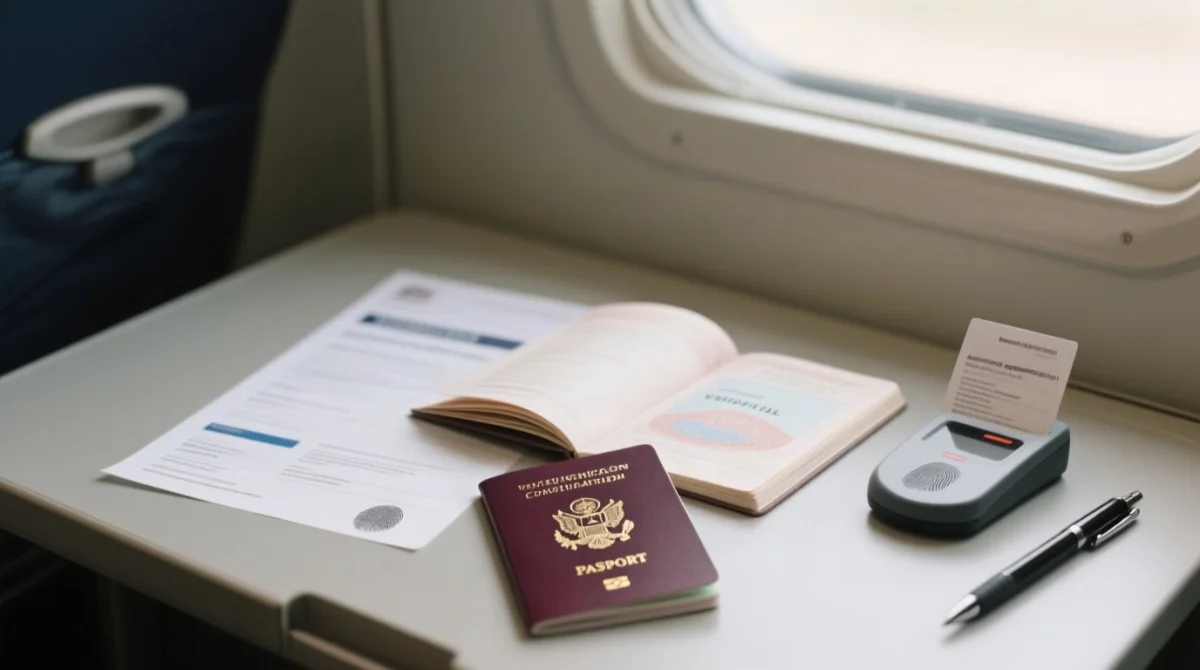
Applicants complete an online form and attend an in-person biometric appointment (fingerprints and photograph) at a visa application centre. Standard processing takes up to 3 weeks; the earliest you can apply is 3 months before travel.
Like the Electronic Travel Authorisation, a Standard Visitor Visa permits tourism, family visits, short-term study at an accredited institution, and business activities, but prohibits paid or unpaid work. You cannot switch into another visa category from within the UK. Holding a valid visa exempts you from needing an Electronic Travel Authorisation. The NHS is not covered, so adequate medical insurance is required for the duration of your stay.
Full details are available at gov.uk/standard-visitor.
eTA vs Visitor’s Permit vs Standard Visitor Visa – Key Differences
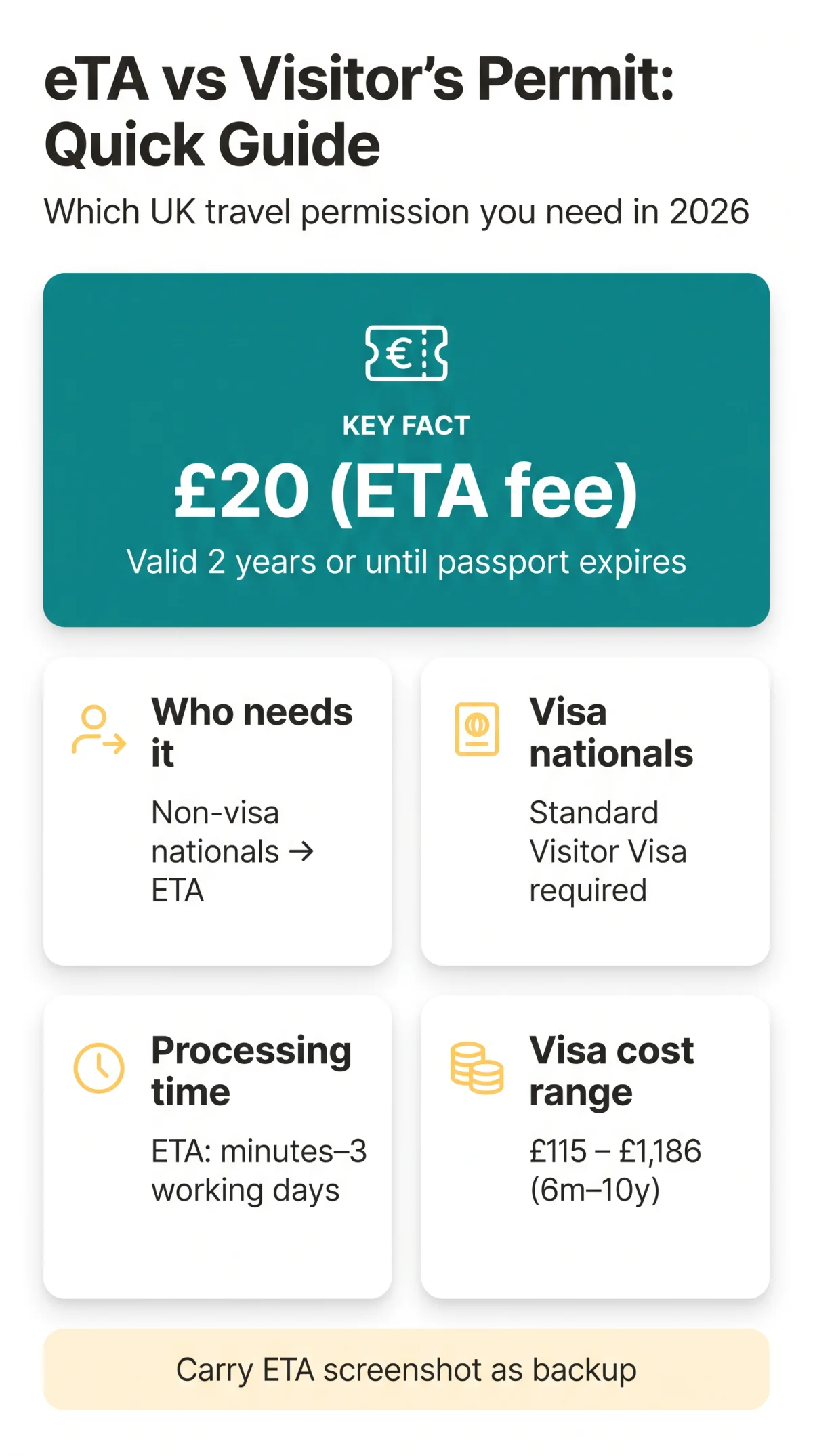
A UK Electronic Travel Authorisation costs £20 and processes in minutes; a Standard Visitor Visa costs £115-£1,186 and takes up to 3 weeks – they serve entirely different traveller groups and are not interchangeable.
| Feature | UK ETA | Standard Visitor Visa | “Visitor’s Permit” (colloquial) |
|---|---|---|---|
| Formal status | Digital travel permission | Entry clearance (visa) | Not a formal document |
| Who needs it | Non-visa nationals | Visa nationals | N/A – informal term |
| Application | Online (UK ETA app / GOV.UK) | Online + biometric appointment | N/A |
| Fee | £20 | £115-£1,186 | N/A |
| Processing time | Minutes to 3 working days | Up to 3 weeks | N/A |
| Validity | 2 years or passport expiry | 6 months – 10 years | N/A |
| Biometrics | No | Yes (fingerprints + photo) | N/A |
| Guarantees entry? | No | No | N/A |
| Multiple entries | Yes | Yes | N/A |
| Max stay per visit | 6 months | 6 months | N/A |
Nationality determines which document you need; a “visitor’s permit” maps to neither – it is the informal name for permission to enter granted by a Border Force officer at the port of entry.
eVisa vs eTA – Different Things in the UK Digital System
A UK eVisa records a digital immigration status for residents and workers; an Electronic Travel Authorisation (ETA) is a £20 short-term travel permission for temporary visitors. Both are part of the same UK digitalisation programme but serve fundamentally different functions and are not interchangeable.
An eVisa is accessed via a UKVI online account and represents a person’s ongoing immigration status. Examples include Skilled Worker visa holders, Student visa holders, persons with settled or pre-settled status, and those with Indefinite Leave to Remain. The eVisa exists for as long as the underlying visa or status remains valid.
An Electronic Travel Authorisation, by contrast, is a passport-linked digital permission granted to non-visa nationals visiting the UK for stays of up to 6 months. It costs £20, remains valid for 2 years or until the linked passport expires, and does not confer immigration status. A traveller holding an eVisa does not need an Electronic Travel Authorisation, and vice versa. “Travel authorisation” is the umbrella term for any pre-travel digital permission system; the UK’s implementation is the ETA.
| Feature | eVisa | Electronic Travel Authorisation (ETA) |
|---|---|---|
| Purpose | Records immigration status | Short-term travel permission |
| Holder | Residents and workers | Visitors (non-visa nationals) |
| Validity | Tied to underlying visa length | 2 years or passport expiry |
| Cost | Visa fee already paid | £20 |
ETA Denials, Transit Rules & Practical Tips
If your Electronic Travel Authorisation (ETA) application is denied, the outcome depends on the reason. A technical rejection (incomplete form, passport data mismatch, expired passport) lets you reapply, but the £20 fee is lost. A substantive refusal means you do not meet eligibility criteria; there is no right of appeal, and you must apply for a Standard Visitor Visa (£115+, biometric appointment, up to 3 weeks processing). Common rejection reasons include passport data errors and undisclosed immigration history.
The Common Travel Area (UK, Ireland, Isle of Man, Channel Islands) has no border checks on the Ireland-Northern Ireland land border, yet travellers must still hold a valid ETA or visa before entering. For example, a non-visa national travelling from Dublin to Belfast will not pass through immigration control but is legally required to hold an ETA before entering the UK. Legal residents of Ireland from non-visa national countries are exempt with proof of residency.
Carry a printed screenshot of your Electronic Travel Authorisation confirmation as backup in case airline systems fail to verify it digitally. Neither an ETA nor a Standard Visitor Visa provides NHS coverage; arrange private medical insurance before travel.
FAQ: eTA, Visitor’s Permit, and UK Travel Documents
What is the difference between eTA and visitor’s permit?
An eTA (Electronic Travel Authorisation) is a £20 digital travel document you apply for online before travelling to the UK. A “visitor’s permit” is not an official document; it is a colloquial term for the permission to enter granted by a Border Force officer at the border.
Do UK citizens need an eTA to travel to the UK?
No. British and Irish citizens are exempt. The eTA applies only to nationals of countries included in the UK’s ETA scheme travelling for short stays up to 6 months.
Can I travel to the UK without a visa if I have an eTA?
Yes – for ETA-eligible nationals. It replaces a short-stay visa but does not guarantee entry; Border Force decides at the port.
How long is a UK eTA valid for?
2 years from approval or until your passport expires, whichever comes first. Multiple entries are allowed during the validity period.
What is the difference between an eVisa and an eTA?
An eTA is a 2-year visitor travel permission (stays up to 6 months); an eVisa records immigration status (work, study, settlement). Not interchangeable.
What happens if my eTA application is refused?
You must apply for a Standard Visitor Visa (biometric appointment, £115+ fee, up to 3 weeks). There is no formal appeal for eTA refusals. The £20 fee is non-refundable.
Do children need their own eTA?
Yes. Every traveller, including infants, requires an individual eTA application and a separate £20 fee. A parent or guardian submits the application on the child’s behalf.
Does arriving from Ireland mean I don’t need an eTA?
No. Although Ireland and the UK are part of the Common Travel Area with no routine border checks, you are legally required to hold the correct UK immigration permission before entering.
How much does a UK eTA cost?
£20 per person. The fee is non-refundable regardless of whether the application is approved, rejected, or refused.
Which countries’ nationals need an eTA for the UK?
The UK eTA scheme covers non-visa nationals from countries including the United States, Canada, Australia, New Zealand, Japan, South Korea, and EU member states, except Ireland. Check the full list on the GOV.UK website.
This guide is maintained by our editorial team, who have tracked the UK ETA scheme since its launch in October 2023. Data reflect Home Office figures through the end of 2025. Disclaimer: This article is for informational purposes only and does not constitute legal advice. For official guidance, refer to GOV.UK or consult a qualified immigration solicitor. This is not a government website.